
Caddock and W. Zbyszko Wrestle to Draw
Earl Caddock had a relatively short but storied professional wrestling career in the late 1910s and early 1920s. Making his professional debut in 1915 after winning three AAU National titles in amateur wrestling, Caddock only wrestled professionally until 1922. However, he would be recognized as world champion after defeating Joe Stecher in April 1917. Caddock would lose the title back to Stecher in 1920. The rematch was delayed by Caddock’s Army service during World War I, when he saw fighting in France.
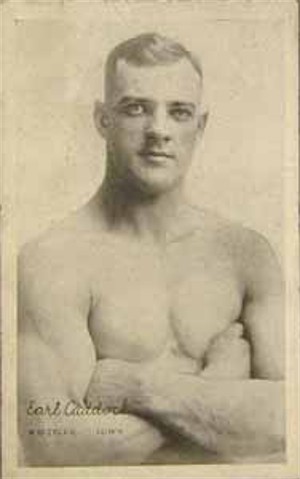
World Heavyweight Wrestling Champion Earl Caddock from the Public Domain
Prior to leaving for France, Caddock defended his title against Wladek Zbyszko on Friday, February 8, 1918 in front of several thousand soldiers in Fort Dodge, Iowa. Caddock was billeted near this town preparing to ship out overseas. The match was scheduled for 2 out of 3 falls with a 2 hours, 30 minutes time-limit.
Caddock and Zbyszko engaged in a long, gruelling match for the soldiers. Caddock was the clear favorite of his fellow soldiers but there was no nationalistic antagonism towards Zbyszko.
The men wrestled for 1 hour, 20 minutes before Earl Caddock secured a wristlock and head scissors to score the first fall. Both men were breathing heavily as the 15-minute rest period between falls began.
The second fall began and continued for another 31 minutes of exhaustive, defensive wrestling until Zbyszko was able to pull Caddock into a side hip lock.
Zbyszko threw himself backwards landing all 226-pounds of his bodyweight on top of a Caddock. The 185-pound Caddock was pinned for the second fall. It took Caddock’s corner several minutes to bring Caddock back to his feet and revive him for the final fall.
Caddock primarily stayed away from Zbyszko for the next 37 minutes. The match ended at the curfew of 1:15 a.m. Ed Smith, the referee for most of the world title matches since the first Gotch-Hackenschmidt match in 1908, declared Caddock the winner on points even though both men had scored a fall. Normally, the match would be considered a draw.
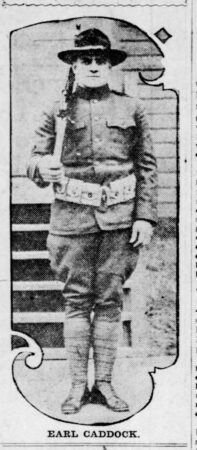
World Champion Earl Caddock in military uniform from the February 9, 1918 edition of the St. Louis Post-Dispatch (Public Domain)
The lack of a title switch in this match is interesting. We are well into the “worked” era by this time. I have no evidence that this match was anything other than a prearranged exhibition. Yet, Caddock is heading out of the country for an undetermined period of time and the promoters left the world championship on Caddock.
Since Zbyszko wasn’t going anywhere, it would make sense to drop the belt to him. When Caddock returned, he could beat Zbyszko for the title setting up the Stecher-Caddock rematch. However, the promoters must have wanted to keep Caddock undefeated and trust that he would be back soon to have what must have been a big money match with Stecher.
It may also have been a realization that with America entering World War I, entertainment like sporting events may be curtailed for a few years. Whatever their reason, the promoters didn’t switch the belt to Zbyszko.
After distinguished service in France, Earl Caddock did return to the United States and back to the wrestling ring. He would meet Joe Stecher in a rematch during early 1920 but that is a story for another post.
You can leave a comment or ask a question about this or any post in the comment section below or on my Facebook page or Twitter profile.
Sources: St. Louis Post-Dispatch, February 9, 1918 edition, p. 8 and Earl Caddock’s National Wrestling Hall of Fame page
Pin It
